



TL;DR
- Frequency capping limits how often one person sees the same ad in a set time.
- Every cap has three parts: the number of impressions, the time window, and the level it applies to.
- Caps stop ad fatigue, protect budget, and keep people from getting annoyed with your brand.
- A DSP checks the cap before it bids. If the limit is hit, it skips the auction.
- Caps across several DSPs are hard. Cookie sync match rates are often only 30 to 50%.
- The right cap depends on audience size, channel, campaign goal, and funnel stage.
- Rotate creatives and review caps during the campaign, not just at launch.
Table of Contents
- What is frequency capping?
- Why frequency capping matters
- How frequency capping works in programmatic: step-by-step
- Why cross-platform frequency capping is hard
- How to set the right frequency cap: key factors
- Frequency capping levels: campaign, ad group, creative
- Common frequency capping mistakes
- How BidsCube Can Help
- Summary
-
FAQs
- 1. What is frequency capping in advertising?
- 2. What is a good frequency cap for a programmatic campaign?
- 3. Why is frequency capping harder across multiple DSPs?
- 4. Should retargeting campaigns have a higher frequency cap than prospecting?
- 5. What happens if I don't set a frequency cap?
- 6. Does frequency capping work the same way on CTV as on display?
Many advertisers set a frequency cap by gut feel. Three a day sounds fine. Five a week sounds safe.
But guessing gets expensive. The cap shapes ad fatigue, reach, and how fast your budget burns. In programmatic, it’s even trickier. Thanks to a number of DSPs working in unison, all showing the same person your ad at once, and none of them knowing about each other.
Which is why Frequency control will be a setting in all your campaigns. It is not an add on you turn on down the line. The payoff can be large. The Trade Desk studied 100 deals over a five-day period and found that advertisers who managed frequency in one environment achieved six times the effective reach.
Let’s break down how it works and how to set it.
What is frequency capping?
What is frequency capping? It’s a limit on how many times one ad is shown to one user in a set period of time. You’ll also hear it called an impression cap. That’s the short answer to what is frequency capping in advertising. Our frequency cap glossary has a longer definition.
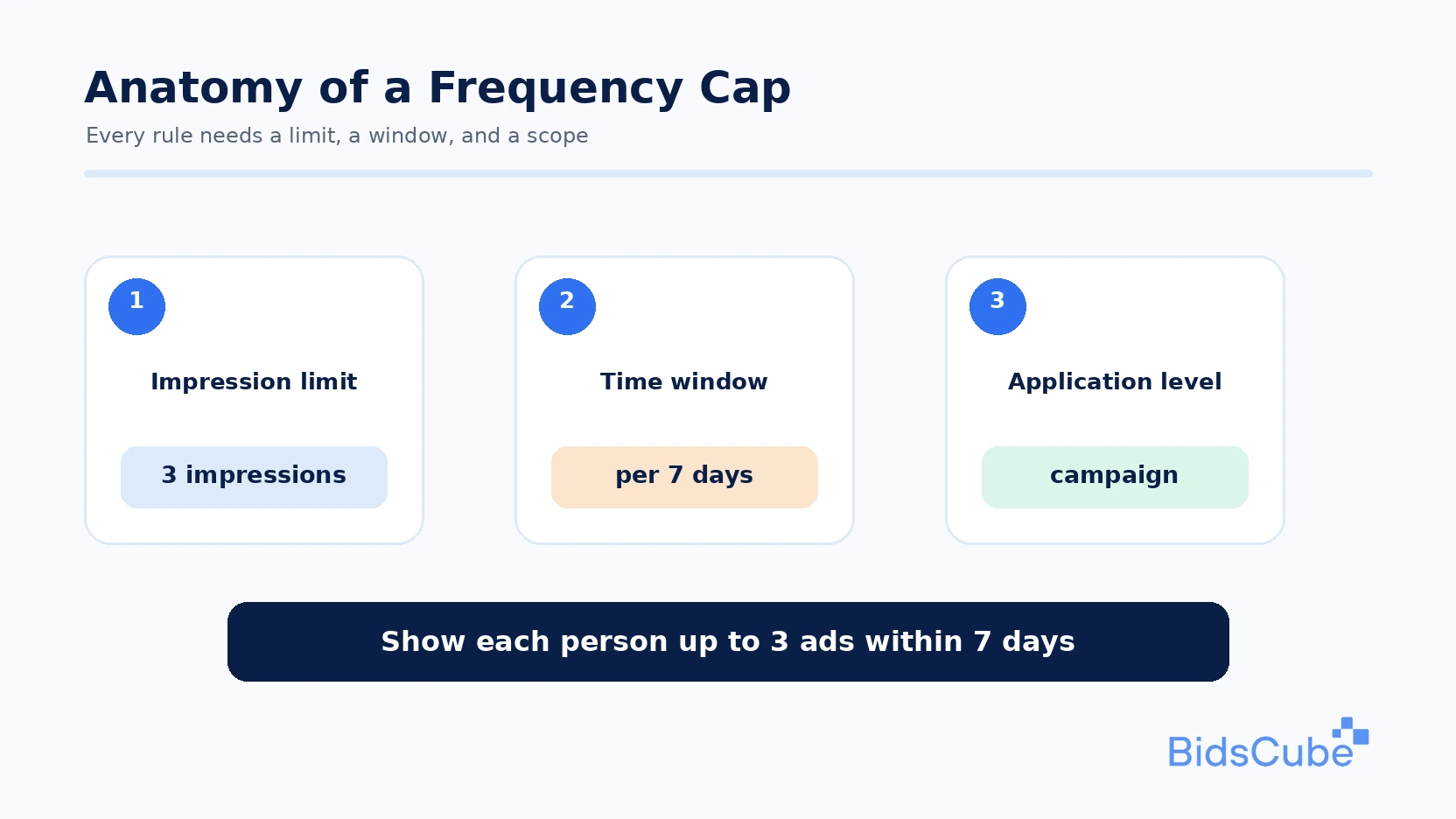
Every capping rule has three parts:
- The limit. Size of impressions get one user. For example, 3.
- The time window. Window the limit covers: an hour, a day or week.
- The level. A Campaign, AdGroup or Creative, where the rule is applied.
So “3 impressions per user per day at the campaign level” is a full rule.
Why frequency capping matters
So, what is frequency capping and why does it matter? Three reasons.
- It stops ad fatigue. The first time someone sees your ad, they might click. By the tenth time, they scroll past. CTR drops with each repeat.
- It protects your budget. Without a cap, a big chunk of spend can land on a small group of the same people. You pay again and again for no new reach.
- It keeps your brand liked. Being followed all day by the same banner is not something enjoy. Interests becomes too irritating with pseudo repeats.
Good frequency capping advertising keeps all three in check.
How frequency capping works in programmatic: step-by-step
Here’s how a frequency cap programmatic advertising setup works inside a DSP:
- The DSP tracks each user. It counts impressions per person through an ID. That can be a cookie, a mobile ad ID, or a device ID.
- A bid request comes in. Before it bids, the DSP checks how many times this user has seen the ad.
- The limit is hit. The DSP skips the auction. It doesn’t bid, even if the audience and context fit perfectly.
- The limit isn’t hit. The DSP bids as usual.
It all happens in milliseconds. The user never notices.
Why cross-platform frequency capping is hard
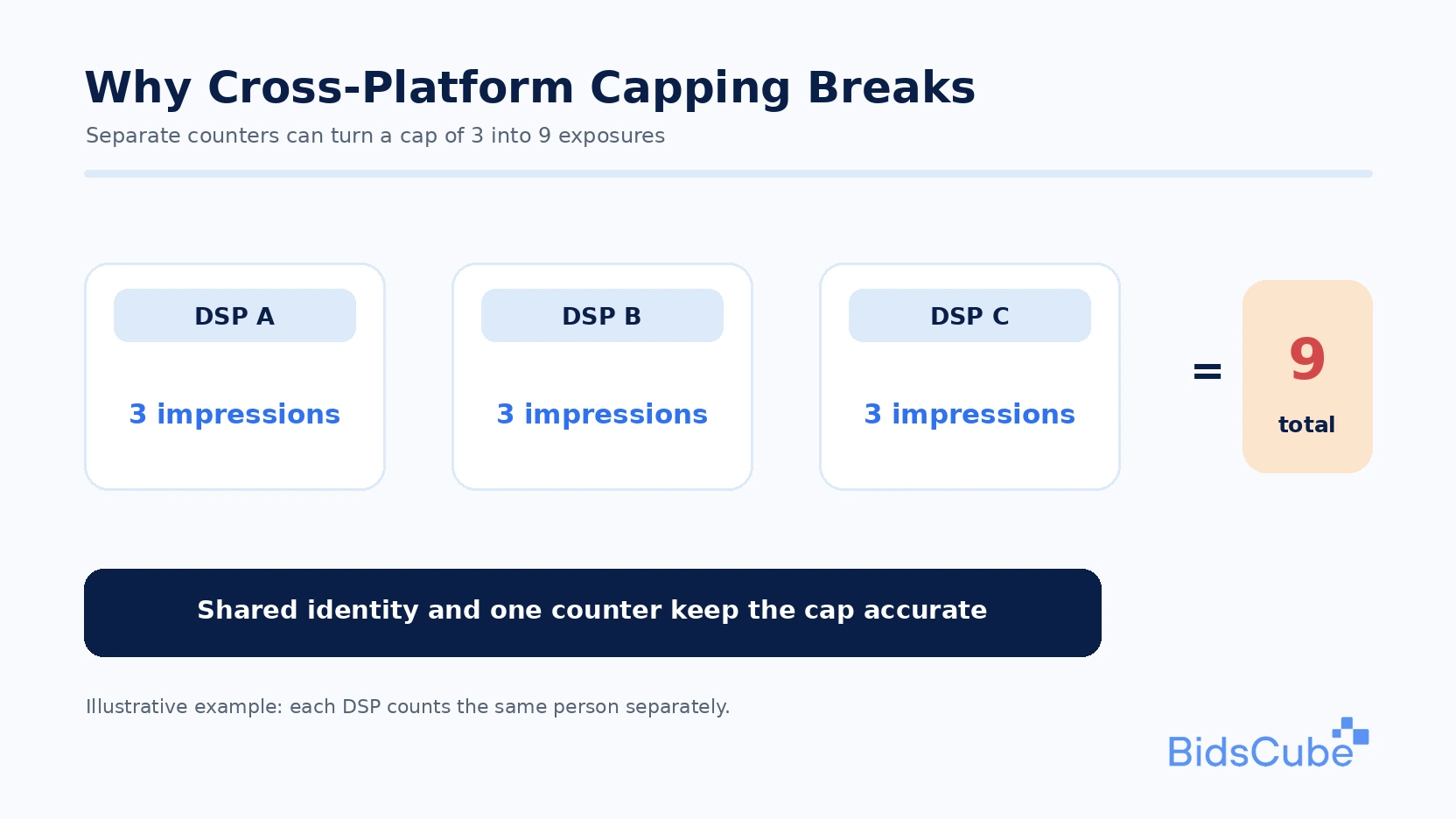
Here’s the catch. One DSP only sees its own impressions.
If you run campaigns through two or three DSPs, each one counts separately. To link them, systems need cookie syncing, also called identity resolution. Cookie syncing matches user IDs across platforms. Our guide on cookie syncing explains how it works.
The trouble is that match rates are low. A typical cookie sync matches only 30 to 50% of users. In Safari and Firefox, it’s close to zero, because those browsers block third-party cookies. So a user can see more ads than you planned. Your cap in each DSP can be perfect, and the total still runs over. Three DSPs with a cap of 3 each can mean 9 impressions for one person.
The simplest fix is to run more of your buying through one DSP. Fewer systems, fewer blind spots.
Want one place to control frequency across channels? Try the BidsCube DSP for display and CTV.
How to set the right frequency cap: key factors
There’s no single magic number. How to set frequency cap rules depends on four things.
- Audience size. A small audience can handle a higher frequency. A broad one needs a lower cap so you reach more new people.
- Channel. CTV and audio usually need lower caps. People watch and listen with more attention, so fewer repeats do the job. Display can take higher caps. Online video sits in the middle.
- Campaign goal. Retargeting can run a higher cap, because these people already know your brand. Prospecting needs a lower cap, since you want to reach as many new people as you can.
- Length and funnel stage. A two-week launch can push harder than a six-month brand campaign. And, folks at the bottom of the funnel need many more reminders than those closer to the top.
Here’s a simple starting point. Ditch the commandment, treat it as a test:
| Channel or goal | Starting cap | Why |
|---|---|---|
| Display, prospecting | 3 to 5 per day | Lots of impressions, low attention per view |
| Display, retargeting | 5 to 8 per day | Warm audience, higher intent |
| Online video | 2 to 3 per day | Moderate attention |
| CTV | 1 to 2 per day, 6 to 10 per week | High attention, big screen |
| Audio | 2 to 3 per day | Focused listening |
Your optimal ad frequency will differ. So as the frequency increases watch CTR and conversions. Results are flattening, you hit your ceiling.
Frequency capping levels: campaign, ad group, creative
Caps can sit at three levels. Each one does a different job.
- Campaign level. Cap total impressions across the entire campaign by user. Use it to shield your budget.
- Ad group level. Restricts impressions to a single group (one audience, or one type of placement). This is used when groups vary in their objectives.
- Creative level. Prevents one certain ad from being shown way too often.
Here’s when creative rotation beats a hard limit. Say your campaign cap is 6 per week. You can show one banner 6 times. Or you can rotate three banners, 2 times each. The user sees your brand just as often. But they see something fresh each time, so fatigue sets in more slowly.
For CTV, rotation matters even more. Our 5 creative tips for CTV advertising show how to keep spots fresh.
Common frequency capping mistakes
These three mistakes repeat themselves over and over again. Letting them slip through the cracks is precisely what frequency capping best practices are all about.
One global cap for everything. Using the same cap for CTV, display, retargeting, and prospecting ignores how different they are. Split caps by channel and goal.
Capping without rotating creatives. A cap slows fatigue. It doesn’t stop it. If people see the same banner every time, they still tune it out. Rotate.
Set it and forget it. A lot of the teams set caps at launch(this could be October 2023 in your case) and then do not bother to revisit it. Audiences consolidate, outcomes fluidize and hats lose their fit. Review it every week or two.
One more thought: Frequency is not the sole issue with a campaign that stagnates. Fatigue in the data may manifest itself as weak creative or the wrong audience.
How BidsCube Can Help
With BidsCube DSP, you can take control over the frequency of your ads.
- Caps at the campaign level to safeguard your overall budgets
- Line-level caps to set different limits for each audience or placement.
- Cross-channel caps for CTV and display, so an user is not bombarded across screens.
- Real-time reports to measure frequency, reach through the duration of the campaign, and results in the campaign.
Publishers can sell into this demand through the BidsCube SSP. BidsCube has 10+ years in programmatic and 230+ clients. See their reviews on Clutch. For more ideas on planning campaigns, read our strategic approaches to programmatic advertising.
Summary
A frequency cap decides how often the same person meets your ad. If locked it in too high, you just burn the budget on jaded observers. Too low and your message won’t be remembered. Determine size by audience, channel & goal and test. Pair caps with creative rotation, and keep as much buying as you can in one DSP. That’s the most reliable way to find your optimal ad frequency.
Talk to BidsCube about setting smarter frequency caps for your next campaign.
Our tech staff and AdOps are formed by the best AdTech and MarTech industry specialists with 10+ years of proven track record!

FAQs
1. What is frequency capping in advertising?
What is frequency capping in advertising? It’s a limit on how many times one user sees the same ad in a set time, like 3 per day.
2. What is a good frequency cap for a programmatic campaign?
It depends on the channel and goal. Many display campaigns start at 3 to 5 per day. CTV often starts at 1 to 2 per day. Test and adjust from there. That’s the core of how to set frequency cap rules.
3. Why is frequency capping harder across multiple DSPs?
Each DSP only counts its own impressions. Linking them needs cookie syncing, which often matches only 30 to 50% of users. In Safari and Firefox, it’s close to zero.
4. Should retargeting campaigns have a higher frequency cap than prospecting?
Usually, yes. Retargeting audiences already know your brand, so they can take more reminders. Prospecting needs lower caps to reach more new people. This is one of the basic frequency capping best practices.
5. What happens if I don’t set a frequency cap?
Part of your budget can go to the same small group again and again. CTR drops, costs rise, and people may start to dislike your brand. Simply put, what is frequency capping for? It stops exactly that.
6. Does frequency capping work the same way on CTV as on display?
Same logic, but different numbers. Caps are typically lower because CTV viewers have a greater attention span. A frequency cap programmatic advertising plan should set CTV and display caps separately. Good frequency capping advertising treats each screen on its own terms. And if you still wonder what is frequency capping and why does it matter on TV, it’s because a repeated spot on a big screen is hard to ignore.
This Article's Ad Tech terms


