



- A white label DSP is a ready-made programmatic platform, and instead of building one from scratch, you license and operate it under your brand name.
- Pricing models are generally divide into following categories: SaaS monthly license, rev share as a % of media spend, managed service, and last but not least hybrids floor-plus-percentage deals.
- Narrow down the key price factors (SSP integration, channel coverage, data partners, breadth of report, brand safety tools, support level, custom development)
- Keep an eye out for hidden fees: data costs, ad verification, overage charges, custom integrations and time to train the team.
- Typically, white-label reaches breakeven between 3 to 6 months compared to a custom build costing $150K-$1.5M+ over a 12-24 month buildout timeline.
Table of Contents
More and more companies prefer to have their own programmatic buying platform: ad agencies tired of paying third-party margins, media buying teams that require transparency, and AdTech startups that want maximum speed to market.
The first question is always the same: how much does a white label DSP cost, and what exactly makes up that price?
Budgeting is tough, as numbers are rarely published by vendors.
In this article, we present a candid model breakdown: the models vendors keep as secrets, reasonable ranges in the market, price drivers that can raise or lower the price, and those little annoying costs to catch before you sign.
What Is a White-Label DSP?

A white-label DSP is a ready-to-deploy programmatic buying platform that you license from a vendor and rebrand under your own name. Your clients see your logo and your domain. The vendor maintains the technology behind it.

The contrast with a custom build is sharp. A demand-side platform will cost millions and take years to build (starting in the mid–50s and up); every technical risk falls on you. Deploy a white-label: This is available in a matter of weeks if you pay a license fee, and all of the technical burden will be supporting you through the vendor.
These are the usual suspects: trading desks, ad agencies, media buyers, adtech startups, and media companies that want a programmatic platform of their own but lack the adtech engineering department.
White Label DSP Pricing Models
Five models cover almost every offer on the market.
| Pricing Model | How It Works | Who It Suits | Typical Cost Range |
| SaaS / monthly license | Fixed monthly fee for the platform, independent of media spend | Companies with predictable volume | $2K-$50K+ per month |
| Revenue share / % of media spend | Vendor takes a percentage of spend running through the platform | Starters with low initial spend | 5-15% of spend |
| Managed service | Platform plus the vendor’s team runs your campaigns | Teams without in-house traders | License plus service fees |
| Hybrid | Fixed floor plus a percentage of spend above a threshold | Growing teams between SaaS and rev share | Floor $2K-$10K plus 3-8% |
| Self-serve plus custom development | License plus paid custom features or integrations | Companies with specific product needs | License plus hourly or project rates |
SaaS pricing rewards scale: the more you spend, the smaller the fee is as a share of it. Revenue share flips that logic and rewards starting small. Managed service costs more but removes the need for in-house operators from day one.
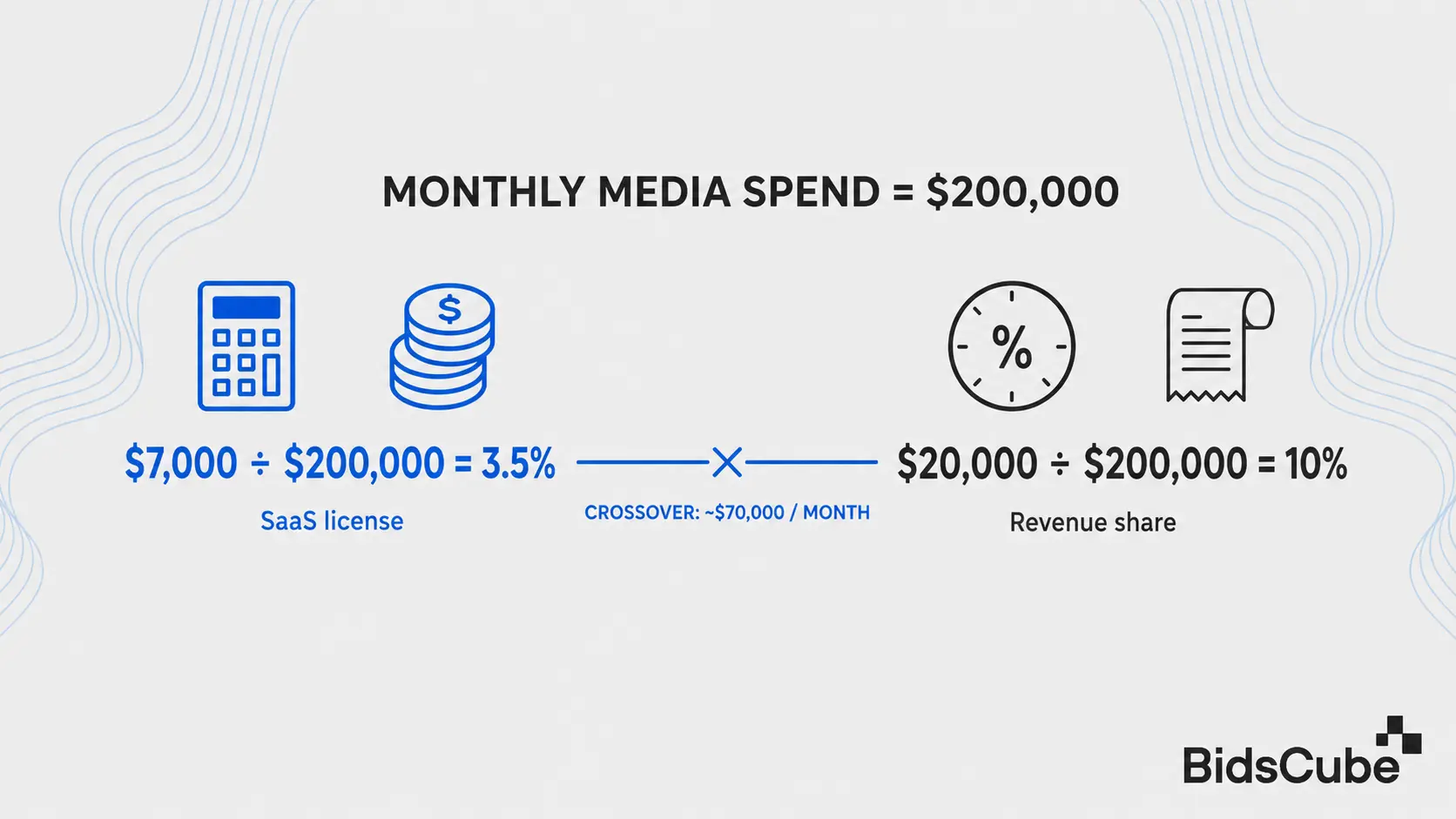
A simple worked example shows the difference. Suppose your trading desk runs $200,000 in monthly media spend. On a $7,000 SaaS license, the platform costs 3.5% of spend. On a 10% revenue share, the same month costs $20,000. The crossover point sits around $70,000 of monthly spend in this example. Below it, revenue share is cheaper.
Above it, the fixed license wins, and the gap widens every month you grow. This is why many media buyers start on revenue share and renegotiate to SaaS once volume stabilizes.
Typical White-Label DSP Cost Ranges
| Plan | Monthly Cost | Included Features | Best For |
| Entry-level / starter | $2,000-$5,000 | Basic bidder, display and video, 10-20 SSP integrations | Small agencies, startups |
| Mid-market | $5,000-$15,000 | Multi-channel: display, video, mobile, CTV; advanced targeting, reporting API | Agencies with $500K+ monthly spend |
| Enterprise / full-featured | $15,000-$50,000+ or custom | All channels, custom algorithms, data partnerships, SLA | Large trading desks, media conglomerates |
| Revenue share equivalent | 7-12% of media spend | Platform access without large fixed costs | Launching without upfront budget |
Important note: These are indicative market ranges (open to fluctuations). The true cost varies based on the vendor, volume, and feature set you negotiate. They should be used to sanity-check quotes, not as a price card.
Want a real number instead of a range? Request BidsCube white-label DSP pricing for a quote based on your volume and channels.
What Affects White Label DSP Cost
White label DSP pricing depends on more than the base license. The final cost reflects the supply connections, channels, data tools, reporting, support level, and custom work your business needs.
- Number of SSP integrations included. Supply is the product. Each additional SSP integration means extra cost, or it comes included in premium plans.
- Channel coverage. Display-only platforms sit at the bottom of the range. Each added channel, video, CTV, audio, DOOH, or mobile, adds to the price.
- Data partnerships. Universal ID support such as UID 2.0 and RampID, DMP integrations, and contextual data feeds all carry licensing costs.
- Reporting and analytics depth. A basic dashboard is standard. A real-time analytics API and custom reporting push you up a tier.
- Brand safety tools. DoubleVerify, IAS, or HUMAN Security integrations come as a separate cost or as part of higher plans.
- Technical support and SLA. 24/7 support with response time guarantees costs more than business-hours email.
- Onboarding and training. Most vendors charge a one-time setup fee, commonly $5K-$20K.
- Custom development. Custom features, UI white-labeling beyond the standard, and custom algorithms bill at hourly or project rates.
Not all setups are the cheapest. Evaluate your traffic estimates, requirements from your clients, and future growth projections, and then question vendors on which features are not included in the quoted price.
White-Label DSP vs Custom DSP Build: Cost Comparison

The build vs buy decision gets much easier when the numbers sit side by side.
| Cost Factor | White-Label DSP | Custom Build From Scratch |
| Upfront cost | $0-$20K setup | $150K-$1.5M+ development |
| Monthly cost | $2K-$50K license | $20K-$80K infrastructure plus team |
| Time to launch | 2-8 weeks | 12-24 months |
| SSP integrations | Pre-built, 30-100+ | Build every one yourself |
| Customization | Limited to platform features | 100% control |
| Risk | Low, vendor manages the tech | High, tech responsibility is yours |
| ROI break-even | 3-6 months | 2-4 years |
A custom DSP only wins this table on customization. If owning unique bidding technology is your strategy and you have the engineering team for OpenRTB work at scale, build. Otherwise the math points one way.
Hidden Costs to Consider
A platform quote rarely shows the full operating cost. Data, verification, infrastructure, integrations, and team ramp-up can change the actual budget after launch.
- Data costs. Third-party data segments and Universal ID licensing can add 15-30% to your effective CPM.
- Ad verification. Brand safety and fraud prevention tools typically add $1K-$5K per month on top of the license.
- Infrastructure overage. If pricing is based on QPS or data volume, exceeding the limits triggers overage fees. Ask where the thresholds sit.
- Technical integration. Custom connections to your CRM, DMP, or billing system are billed separately.
- Training and onboarding time. No matter how good the platform is, the first 1-3 months will see team efficiency lower than expected. Plan for the ramp, not just the license.
Ask for a breakdown of the pricing before any signing. Having established user caps, monthly fees, and implementation, you avoid double-digit shocks once campaigns are mid-flight.
How to Evaluate White-Label DSP Vendors
Price only matters in context. Run every vendor through the same checklist.
- Number and quality of SSP integrations, since they define your inventory coverage.
- OpenRTB version and compliance with current technical standards.
- Latency and infrastructure stability, backed by a written SLA.
- Transparency on auction dynamics and margin visibility.
- Reporting granularity and data export options, including log-level access.
- Support model and guaranteed response times.
- Pricing transparency, with a direct question about hidden fees.
- Product roadmap and development velocity over the past year.
Two practical tips make the evaluation sharper. First, ask each vendor for a reference client at your spend level, not their biggest logo. A platform tuned for a $5 million trading desk can feel empty at $100,000 per month, and the reverse is also true. Second, model your total cost of ownership for 12 months, including the setup fee, data costs, ad verification, and the ramp period. The cheapest quote on a one-month view is often the most expensive on a one-year view.
How BidsCube Can Help
BidsCube has a white-label DSP, which comes with transparent pricing and no surprise line items. The license includes a production bidder, pre-built SSP and ad exchange integrations, multi-channel support across display, video, mobile, and CTV, targeting, reporting, and brand safety hooks. Setup takes weeks, and the pricing model scales with your stage: start lean, grow into higher volume without replatforming.
If your plans go beyond buying, the BidsCube SSP and the White-Label Ad Exchange extend the same stack to the sell side and to running your own marketplace. Independent reviews on Clutch show what clients say about the economics in practice.
Buyers fixate on the license fee, but the license is the cheapest part of the decision. What actually determines ROI is inventory coverage, margin transparency, and how fast your team gets productive on the platform. A $5K platform your traders fight with costs more than a $15K platform that pays for itself in month four.
Roman Vayukov, CEO at BidsCube
Final Thoughts
The cost of white label DSP platforms is far more predictable than custom development, and the structure is easy to navigate once you know the models: SaaS for predictability, revenue share for a lean start, managed service when you’re under-operators, and hybrid for everything else.
Instead of focusing on the headline fee alone, compare vendors on three main things: inventory, transparency & total cost of ownership. Then, cross-check the figures against your own spend forecast. When you are ready for a concrete quote, contact BidsCube and get pricing mapped to your actual volume.
[calback]
FAQ
How much does a white label DSP cost?
Market is $2000-$5000+/mo for entry-level plans and $15000-$50000+/mo for enterprise platforms or 7-12% of media spend in revenue share models. The white label DSP cost will vary according to integrations, channels, and level of support.
What pricing models do white-label DSP vendors use?
There are five to mention: 1) SaaS monthly license; 2) revenue share % of media spend; 3) managed service; 4) hybrid floor-plus-percentage; 5) self-serve license paid custom development.
What factors affect white label DSP pricing?
Number of SSP integrations, channel coverage, data partners, reporting depth, brand safety tools, SLA level, onboarding fees, and custom development capabilities.
Is a white-label DSP cheaper than building a custom DSP?
Yes, almost always. $150K – $1.5M+ upfront + 12-24 month build time + $20K – $80K month to run a custom DSP A white label platform launches in weeks and generally gets to ROI break-even in 3-6 months. Build only in scenarios where the ownership of technology is the strategy itself in the build vs buy comparison
Are there hidden costs in white-label DSP pricing?
The common ones are data and Universal ID licensing, ad verification tools, overage fees on QPS or data volume, custom integrations, and team ramp-up time. Ask every vendor to put these in writing before you compare the cost of white label DSP offers.
How do I choose a white-label DSP vendor?
Score vendors on inventory coverage, OpenRTB compliance, latency and SLA, margin transparency, reporting granularity, support, pricing transparency, and roadmap velocity. A short paid pilot against your real campaigns beats any sales deck.


