



- A DSP allows advertisers to purchase digital ad space via automated real-time auctions. When you say build a trading system it means to build a low latency trading system, not a web app.
- The core components are the bid engine, campaign manager, targeting engine, budget pacing, data integrations, reporting, creative management, and billing.
- The bidder must answer every bid request in under 100 milliseconds, including network time, at thousands of queries per second.
- Approximate cost: $150K-$400K. Time frame, 6 to 12 months. A fully functional solution, to the range of $500K to $1.5M+, takes between 12 and 24 months to build and operates for $20K to $80K per month.
- SSP and ad exchange integrations are the hidden time sink. Each one brings its own testing, QPS quotas, and certification.
- A white-label DSP launches in 2 to 8 weeks for a license fee. Building from scratch makes sense only with a dedicated adtech engineering team and a long-term strategic reason to own the technology.
Table of Contents
- What Is a DSP and How Does It Work?
- Core Components of a DSP Architecture
- How to Build a DSP: Step-by-Step
-
- Step 1. Define your use case and target market
- Step 2. Design the technical architecture
- Step 3. Build the bid engine
- Step 4. Integrate with SSPs and ad exchanges
- Step 5. Build audience targeting and data infrastructure
- Step 6. Implement campaign management UI
- Step 7. Build reporting and analytics
- Step 8. QA, compliance, and launch
- DSP Development Cost and Timeline
- Build vs White-Label DSP: Comparison
- How BidsCube Can Help
- Final Thoughts
- FAQ
Why do companies want their own DSP?
Three reasons come up in almost every conversation: control over bidding logic, ownership of campaign and user data, and a lower ad tech tax compared with paying margins to a third-party DSP forever.
The ambition is reasonable. The difficulty is real. A demand-side platform is one of the most complex systems in the programmatic stack. It needs low latency architecture, real-time bid processing, and dozens of integrations that all have to work at once. And the numbers involved are brutal: industry estimates peg global programmatic spend at over $821 billion by 2026, and these very same trackers count global RTB volume by the trillions of bid requests per day.
This guide shows you how to build a DSP, what each component does, which DSP development costs to expect, and when to go white-label or go custom.
What Is a DSP and How Does It Work?
A DSP, also known as a demand-side platform, is a platform that allows advertisers to buy digital advertising inventory in real-time auctions. Instead of going through the process such that a placement is pursued individually, this requires an advertiser to simply define the targeting and budget tricks, an data driven pipeline that places that ad against millions of impressions each hour.
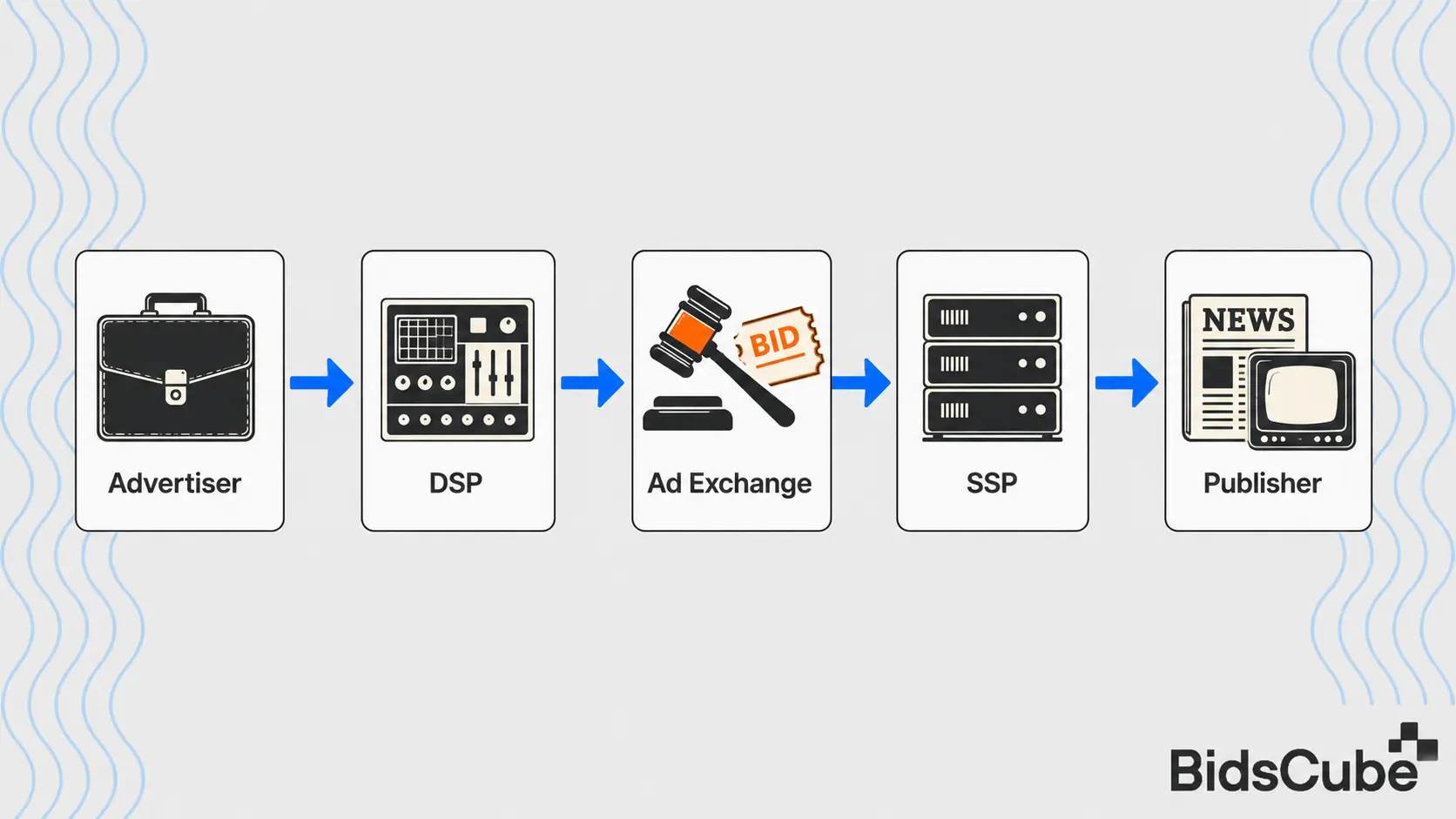
Its place in the programmatic chain is fixed:
Advertiser → DSP → Ad Exchange → SSP → Publisher.
The SSP announces an impression, the ad exchange runs the auction, and the DSP decides whether to bid and at what price.
The key functions are bid management, audience targeting, campaign management, reporting, frequency capping, and budget pacing. Each of those functionalities map to a component for you to design, implement and maintain. The real first lesson in how to create a DSP that buyers trust is to understand them.
Core Components of a DSP Architecture
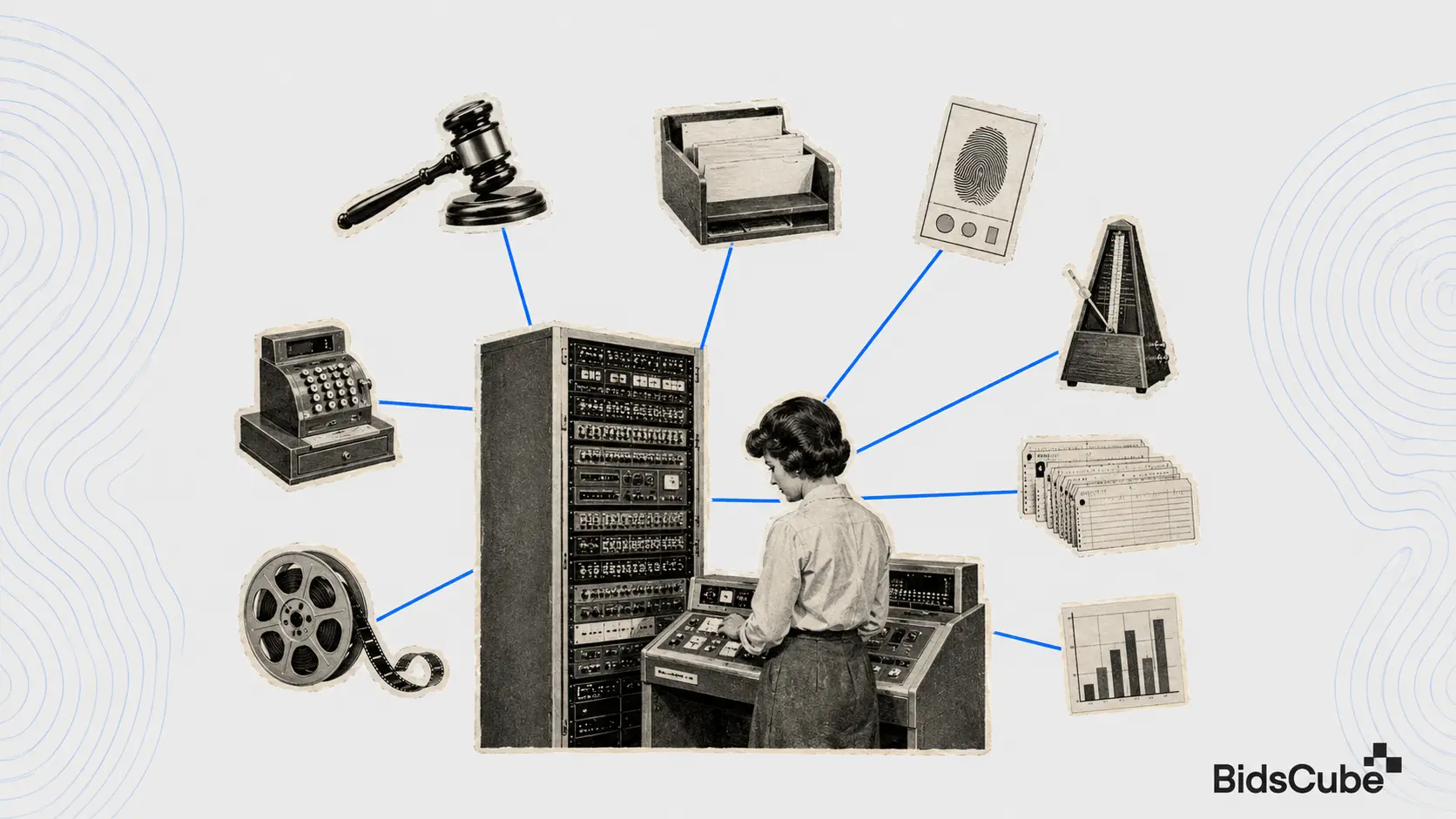
A DSP needs more than a bidding algorithm. It needs connected services that manage campaign delivery, audience data, reporting, creative checks, and financial control at scale.
- Bidder / Bid Engine. The real-time brain of the platform. It receives bid requests and emits bid responses. Latency is everything: the entire decision has to be made in less than 100ms.
- Campaign Manager. Campaigns, ad groups, creatives, budgets, UI and backend. This is how your clients see and evaluate you.
- Audience Targeting Engine. Keeps audience segments, lookalike models, and frequency capping rules that the bidder checks on each request.
- Budget Pacing and Throttling. Spreads spread evenly across the flight window in such a way as not to burn through a daily budget by 9 a.m.
- Data Integration Layer. Integration with DMPs, CDP, first-party data sources, and Universal ID providers.
- Reporting and Analytics. Dashboards with online and backtesting results as well as the data pipeline providing them.
- Ad Server / Creative Management. Serves creatives, manages tracking pixels, and handles creative audits required by exchanges.
- Billing and Finance Module. Cost tracking, margin management, and invoice generation. Unglamorous, mandatory.
Each component affects the rest of the platform. A fast bidder means little without reliable pacing, clean data, usable reporting, and billing that matches actual spend.
How to Build a DSP: Step-by-Step
Building a DSP starts with business decisions before technical ones. Your target users, channels, supply strategy, and service model will shape every part of the architecture.
Step 1. Define your use case and target market
Determine what kind of DSP you are developing too: whether it is a self-serve, managed service, vertical based on mobile, CTV or audio, or a white-label for sale. Choose your focus between display, video, mobile, CTV, audio, and DOOH and type of customers like advertisers, agencies, or resellers.
Step 2. Design the technical architecture
Most modern teams choose microservices over a monolith. Independent bidding, pacing and reporting services scale independently and can be deployed without taking down the entire platform. In the cloud, infrastructure is hosted in AWS, GCP or Azure & orchestrated via Kubernetes.
This is the hard part of the DSP architecture; the IAB has defined that bid response time cannot exceed 100 ms, which means user and campaign lookups must go through in-memory stores like Redis or Aerospike.
Step 3. Build the bid engine
Implement the OpenRTB specification, currently version 2.6 in the 2.x line. The bid engine has four jobs. It parses each bid request to extract user, site or app, impression, and device parameters. It runs the bid decision logic: targeting match, frequency check, budget check, and bid price calculation. It formats the bid response with price and ad markup or a nurl. And it handles win and loss notifications so pacing and reporting stay accurate.
Step 4. Integrate with SSPs and ad exchanges
Without supply, your bidder has nothing to bid on. Connect with the top SSPs: Google AdX, Magnite, PubMatic, OpenX, and the BidsCube Exchange. As every exchange imposes a QPS quota, you require a mechanism for throttling traffic before it reaches the bidder. Plan for seat ID management on every exchange and weeks of integration testing per partner.
Step 5. Build audience targeting and data infrastructure
User matching comes first: cookie sync and Universal ID integration let your platform recognize users in incoming traffic. Add DMP integration for audience segment activation, and a contextual targeting engine so campaigns can run in cookieless environments where no user ID is available.
Step 6. Implement campaign management UI
Advertisers want to be able to create campaigns with a dashboard, upload ads, manage budgets, and schedule them. Introduce pixel management for conversion tracking and remarketing audiences (also add a creative approval workflow to never upload bad ads into an exchange).
Step 7. Build reporting and analytics
It provides real-time reporting on impressions, clicks, spend, CTR, and eCPM. Attribution reporting should also serve view-through and click-through conversions. Advanced users will ask for a custom report builder within the first month, so plan for it.
Step 8. QA, compliance, and launch
Connect with brand safety and fraud prevention through DoubleVerify, IAS or HUMAN Security. Includes GDPR and CCPA-compliant consent management and data retention policies Then load test: exercise production level QPS before launch, you would rather discover your limits before the first traffic spike.
A DSP launch is not the finish line. Teams need to monitor latency, traffic quality, partner integrations, privacy controls, and reporting accuracy as demand and supply grow.
Want the result without the 18-month build? See the BidsCube white-label DSP with pre-built SSP integrations and a live bidder.
DSP Development Cost and Timeline
Budgets vary by scope, but market ranges are consistent enough to plan with.
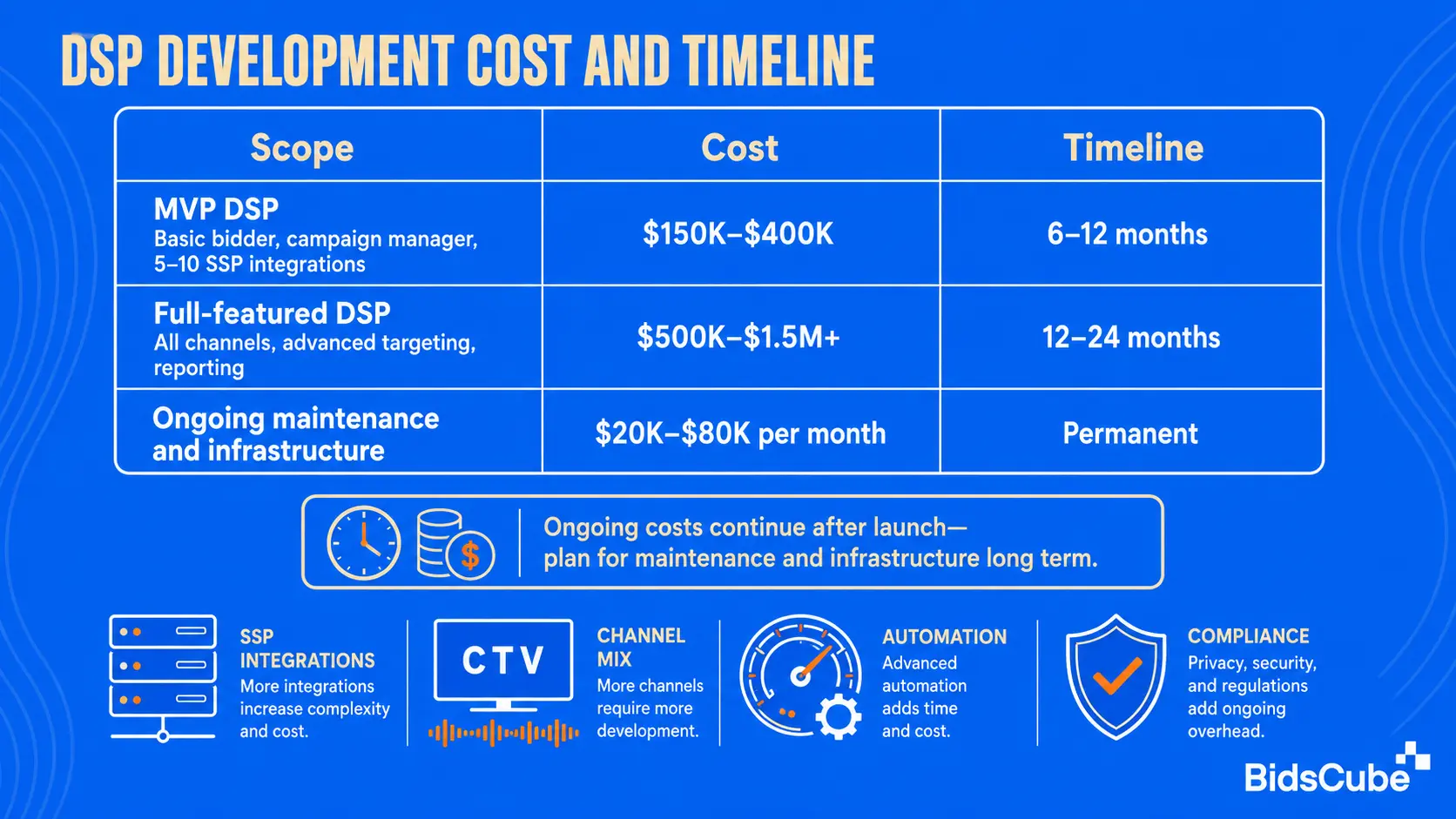
The table below compares typical DSP development costs, delivery timelines, and the ongoing maintenance spend required after launch.
| Scope | Cost | Timeline |
| MVP DSP: basic bidder, campaign manager, 5-10 SSP integrations | $150K-$400K | 6-12 months |
| Full-featured DSP: all channels, advanced targeting, reporting | $500K-$1.5M+ | 12-24 months |
| Ongoing maintenance and infrastructure | $20K-$80K per month | Permanent |
Four factors move the number most: the count of SSP integrations, the channel mix since CTV and audio cost more than display, the level of automation you target, and compliance requirements in your markets. Demand side platform development is never a one-time purchase. The maintenance line continues for the life of the platform, and that recurring cost kills more in-house DSPs than the initial build does.
Build vs White-Label DSP: Comparison
| Parameter | Build From Scratch | White-Label DSP |
| Time to market | 12-24 months | 2-8 weeks |
| Development cost | $500K-$1.5M+ | Licensing fee |
| SSP integrations | Build each one yourself | Pre-built |
| Technical risk | High | Low |
| Customization | 100% control | Limited to platform features |
| Recommended for | Large enterprises with a dedicated adtech team | Agencies, media buyers, startups |
The honest summary: build when owning the technology is itself the business strategy, and license when the business is buying media. Before you build DSP programmatic infrastructure from scratch, price the second year, not just the first.
How BidsCube Can Help
BidsCube offers a ready-to-deploy alternative to custom demand side platform development. The white-label DSP ships with a production bidder, pre-built SSP and ad exchange integrations, targeting, pacing, reporting, and brand safety hooks already in place. You launch under your own brand in weeks.
Teams that want the supply side too can pair it with the BidsCube SSP or run a complete marketplace on the White-Label Ad Exchange. Independent client reviews are available on Clutch.
Everyone underestimates the same two things: integration time and the second year. Writing a bidder is a known engineering problem. Certifying it against twenty exchanges, keeping latency flat while QPS grows, and paying the infrastructure bill every month is the part that decides build versus buy. If media buying is your business, buy the platform and spend your engineers on what differentiates you.
Roman Vayukov, CEO at BidsCube
Final Thoughts
A DSP is a real-time trading system with auction logic, data infrastructure, and a user product wrapped into one platform. Teams that build DSP programmatic stacks in-house from scratch ultimately succeed when they think about it not as an end-dated project but a long-term product investment, one that needs dedicated team members permanently in the organization. A white-label foundation allows anyone else to move faster, cheaper, and with less risk.
Decide which company you are first. Then, if the answer is speed, talk to BidsCube about launching your platform this quarter.
Our tech staff and AdOps are formed by the best AdTech and MarTech industry specialists with 10+ years of proven track record!

FAQ
How do I build a DSP from scratch?
Define your use case, design a low latency microservices architecture, implement an OpenRTB bid engine, integrate with SSPs and ad exchanges, implement targeting and data infrastructure, produce a campaign management UI and reporting, do load testing and ship. That is how to create a DSP in compressed form.
What are the core components of a DSP?
Bid engine, campaign manager, audience targeting engine, budget pacing, data integration layer, reporting and analytics, creative management, and billing. As your latency ceiling is defined by the bidder, it is designed first.
How long does it take to build a DSP?
An MVP takes 6 to 12 months. A complete platform will take anywhere from 12 to 24 months for implementation. White labelling deploys in 2 to 8 weeks
How much does it cost to build a DSP?
MVP: Set aside $150K – $400K, Full Build: $500K – $1.5M+ +$20K – $80K/month for infrastructure and maintenance. To build a DSP sustainably, budget the recurring costs from day one.
What is the difference between building a DSP and using a white-label DSP?
Building gives you full control and full responsibility: every integration, every outage, every compliance update is yours. White-label DSP sacrifices some level of customisation for speed, built-to-order supply and vendor usually-available technology. White label comes out on top for most agencies and media buyers.
What OpenRTB version should my DSP support?
Support OpenRTB 2.6, the current standard in the x line that pretty much every exchange runs today. Have the parser so that new versions and extensions of the parser can be added without rewriting the bid engine.


