



BidsCube operates with publishers and ad platform teams who need to manage their daily operations between CPM and CPC and CPA deals. The IAB reports that programmatic advertising revenue reached $109.4 billion during 2022 so any unreported data would result in actual monetary losses.
Table of Contents
- What Is eCPM? Definitions and Context
- The eCPM Formula Explained
- Why eCPM Matters in Advertising and Marketing
- What Is a Good eCPM? Industry Benchmarks
- Factors That Influence eCPM
- How to Increase eCPM and Boost Ad Revenue
- Expert Insight: eCPM Work Improves When Teams Connect Data and Outcomes
- Case Examples: eCPM Improvement in Action
- Conclusion
-
FAQ
- How do you compute eCPM for a single campaign versus aggregated across multiple ad networks?
- What’s the difference between eCPM and other monetization metrics like CPC or CPA?
- What factors lead to eCPM decreases and what steps do you need to take for diagnosis?
- How can publishers use techniques like header bidding or ad layout optimization to influence eCPM?
- How frequently should you review and adjust your ad setup to maintain or improve eCPM?
That is why what is eCPM matters. The eCPM metric converts all pricing systems into revenue metrics which show earnings per 1000 displayed impressions thus enabling you to evaluate different partners and placement and campaign performance through a single dashboard. The document contains definitions and mathematical explanations and realistic performance targets and operational methods which help generate revenue without compromising user interactions.
What Is eCPM? Definitions and Context
If you search what is eCPM, you will see the same idea repeated: it shows revenue per 1,000 impressions. The “effective” part matters because it works even when you do not sell on a CPM basis.
So, what does eCPM mean in plain terms? It is the average money earned for every 1,000 ad impressions, across any deal type. Industry glossaries often call it effective cost per mille, where “mille” means one thousand.
Publishers use it to compare ad units, pages, geos, and partners. Buyers and networks also use it for performance comparisons when they report blended outcomes.
Learn how supply-side tools support yield work in a BidsCube SSP
The eCPM Formula Explained
The standard eCPM formula is simple:
eCPM = (Total Revenue ÷ Total Impressions) × 1000
That definition answers how is eCPM calculated for most reporting stacks, including ad servers. Google Ad Manager also documents average eCPM as revenue divided by impressions, multiplied by 1,000.
Quick eCPM Calculation Example
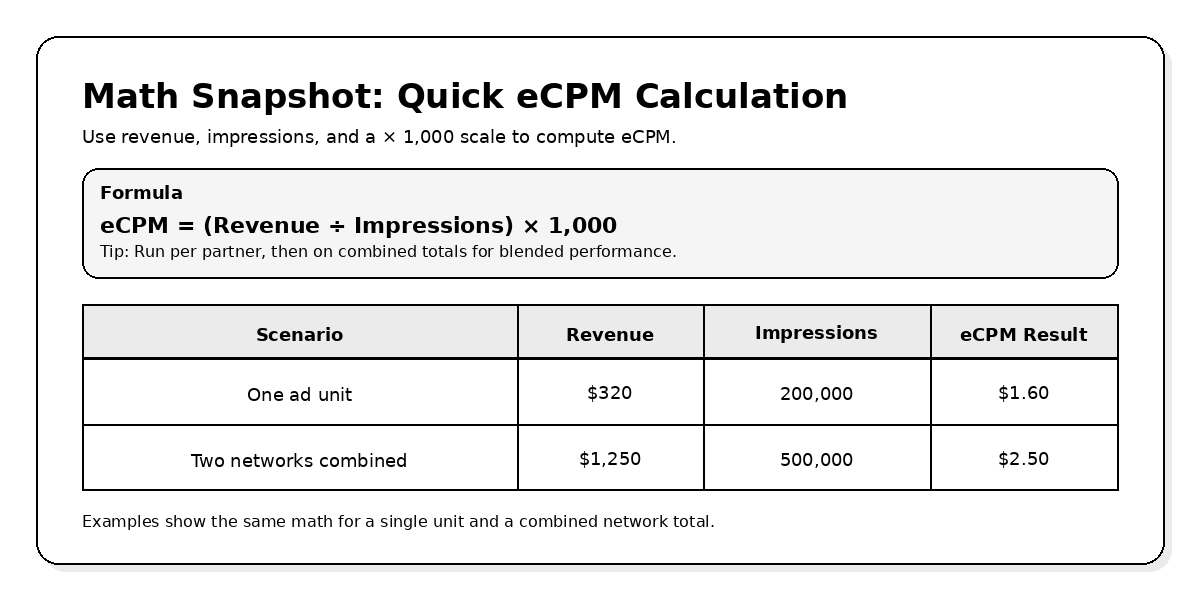
This is the core of eCPM calculation. You take revenue, divide by impressions, and scale to 1,000.
If your team asks how to calculate eCPM per partner, run the formula for each network, then run it again on the combined totals to see blended performance.
Why eCPM Matters in Advertising and Marketing
What is eCPM in advertising used for most often? Comparison. It lets you compare outcomes across formats and pricing models without arguing about CPC vs CPM.
Teams also use eCPM in advertising for decisions like these:
- Which ad unit deserves the best placement
- Which geo needs different floors or demand sources
- Which format mix fits the audience without killing engagement
- Which partner produces high revenue but low quality users
In practice, eCPM in marketing becomes a budgeting and planning tool. You can tie it to page RPM, session value, or lifetime value, depending on the business model.
If you run managed buys, review what a buying platform can support in a BidsCube DSP.
What Is a Good eCPM? Industry Benchmarks
People ask what is a good eCPM, but a single “good number” does not exist. It depends on geo, device, format, viewability, seasonality, and demand access.
Benchmarks enable you to check if your system runs at its predicted performance levels. The Appodeal platform releases a quarterly mobile eCPM report which shows eCPM values by region and format for in-app monetization. The map functions as a tool for finding directions but it does not promise that users will reach their destination.
Directional Benchmarks by Format
| Format | Typical eCPM Pattern | Why It Trends This Way |
| Banner | Lower | High supply, lower attention |
| Interstitial | Mid | Stronger attention, higher impact |
| Video/Rewarded | Higher | Better completion, higher demand value |
If you want the most accurate benchmark, use your own history. Compare the same site section, the same device mix, and the same geo across time.
See user feedback on BidsCube on Clutch.
Factors That Influence eCPM
eCPM moves for many reasons. Some are obvious, and some hide inside the delivery chain.
Key drivers:
- Demand quality: more buyers and better match lifts bids
- Traffic mix: Tier-1 geos usually pay more than long-tail regions
- Viewability and placement: ads that load late or sit below the fold earn less
- Ad format: video often commands higher prices than display
- User experience: heavy layouts can drop engagement, and reduce inventory value
- Floors and auction pressure: poor floor strategy can cap bids or kill fill
If you sell across multiple pipes, supply-path decisions can change pricing fast. Use transparent reporting, and keep logs when possible.
Internal resource: If you want a branded marketplace layer, check white-label AdExchange.
How to Increase eCPM and Boost Ad Revenue
This section covers how to increase eCPM without chasing “tricks” that break the site or app.
1) Clean Up Inventory and Layout
Start with basics. Remove placements that never become viewable. Fix lazy-load rules that delay rendering too long.
Action list:
- Keep top units fast to render.
- Reduce CLS and layout shifts.
- Avoid stacking too many ads in one viewport.
- Test sticky units carefully, and watch bounce rate.
2) Add Competition the Right Way
More demand is often the fastest lift, if the traffic qualifies.
Common options:
- Add more demand partners.
- Use header bidding where it fits your stack.
- Route premium placements to curated demand first.
BidsCube also has a practical explainer on header bidding and Prebid mechanics.
3) Tune Floors With Data, Not Hope
Static floors can punish you when demand drops. Too-low floors leave money on the table during peaks.
A basic workflow:
- Set floors by placement and geo, not site-wide.
- Review win rates and bid density.
- Adjust floors slowly, and measure impact on both eCPM and fill.
4) Segment and Price by Value
Not all impressions are equal. Separate high-viewability, high-engagement inventory from the rest.
Examples:
- Above-the-fold vs below-the-fold.
- Logged-in vs anonymous users.
- Content categories that attract premium budgets.
5) Improve Video Yield Where It Fits
Video can raise blended results, but only if user experience stays intact.
If video is core to your revenue mix, review a dedicated white-label video ad server.
Expert Insight: eCPM Work Improves When Teams Connect Data and Outcomes
For the expert view, here is a quote from Roman Vasyukov, CEO and Founder at BidsCube. He shared it in a BidsCube analysis on picking programmatic partners.
Great programmatic partners do more than provide technology.
That mindset maps directly to eCPM work. Tools matter, but results follow when your team links auctions, user data, layout, and reporting into one feedback loop.
Proof point: Independent reviewers also discuss product experience in BidsCube White-Label AdExchange reviews on G2.
Case Examples: eCPM Improvement in Action
These examples use simplified numbers to show cause and effect.
Case 1: News Site Fixes Viewability
A publisher removed two low-viewability units and improved load timing for the top banner.
- Before: $1.10 eCPM, 68% viewability
- After: $1.45 eCPM, 78% viewability
The site served fewer total impressions, but earned more per 1,000.
Case 2: App Adds Video Without Breaking UX
A mobile app added rewarded video only after natural pause points.
- Before: blended eCPM $2.20
- After: blended eCPM $3.05
The biggest lift came from format mix, not from more ads.
Case 3: Marketplace Uses Better Segmentation
A publisher split premium inventory into its own deal path and raised floors only there.
- Premium placements: +25% eCPM
- Long-tail placements: flat eCPM, better fill stability
Conclusion
eCPM provides you with a single performance metric which functions independently of your pricing system. The tool enables you to identify all revenue loss points which stem from insufficient market demand and poor viewability and inadequate floor planning and incorrect segmentation of your audience.
If you need to calculate eCPM and act on it, keep the workflow simple: track clean inputs, test one change at a time, and measure both revenue and user behavior.
Our tech staff and AdOps are formed by the best AdTech and MarTech industry specialists with 10+ years of proven track record!

FAQ
How do you compute eCPM for a single campaign versus aggregated across multiple ad networks?
For one campaign, use campaign revenue and campaign impressions. For aggregated reporting, sum revenue across networks, sum impressions across networks, then apply the same formula. This approach answers calculate eCPM at both levels.
What’s the difference between eCPM and other monetization metrics like CPC or CPA?
CPC and CPA describe how a buyer pays. eCPM translates the outcome into revenue per 1,000 impressions so you can compare performance across models.
What factors lead to eCPM decreases and what steps do you need to take for diagnosis?
The main factors which cause this issue include changes in traffic patterns and seasonal patterns and lost customer demand and reduced ad visibility and incorrect floor price settings.
How can publishers use techniques like header bidding or ad layout optimization to influence eCPM?
Header bidding can add competition, while layout work can improve viewability and attention. Both can lift results when implemented carefully.
How frequently should you review and adjust your ad setup to maintain or improve eCPM?
Review weekly for anomalies, and run deeper checks monthly. Increase frequency during seasonal peaks, major traffic shifts, or partner changes.
This Article's Ad Tech terms


