



Travelers compare options fast. They jump between metasearch, OTAs, review sites, social feeds, and hotel websites. In Europe, HOTREC noted that Google Hotel Ads reached an 80% usage share by 2023, which shows how much visibility now depends on digital channels.
Table of Contents
- Why Digital Marketing Matters for Hotels
- Crafting a Digital Marketing Strategy for Hotels
- Website Optimization and SEO: The Foundation of Hotel Internet Marketing
- Content and Storytelling: Building Your Brand Online
- Social Media and Reputation Management
- Email Marketing and Personalization
- Paid Media and Programmatic Advertising
- Measuring Success: KPIs for Hospitality Marketing
- Real Examples
- Expert Insight
- Conclusion
- FAQ
This article breaks down a practical playbook for hotels that want more direct demand, stronger repeat stays, and cleaner measurement.
Why Digital Marketing Matters for Hotels
Travelers book with brands they trust, and trust forms online. People look for proof, not promises. They want photos, reviews, clear policies, and quick answers.
A strong digital marketing for hotels plan does not try to beat OTAs at scale. It builds consistent demand, and it protects margin by growing direct bookings.
Key wins hotels usually get from better channel mix:
- Higher share of direct bookings over time.
- Lower dependency on one distribution partner.
- Better guest data for retention and upsell.
- More stable demand during shoulder seasons.
Crafting a Digital Marketing Strategy for Hotels
Start with business targets, not channel wishlists. Define what “success” means for the next 90 days, then build actions around it.
Use this checklist to shape a hotel digital marketing strategy:
- Pick 2–3 priority segments (weekend couples, business travelers, families).
- Map the booking journey by device and channel.
- Align campaigns with revenue management (rates, restrictions, availability).
- Set tracking standards before launch (UTMs, events, call tracking).
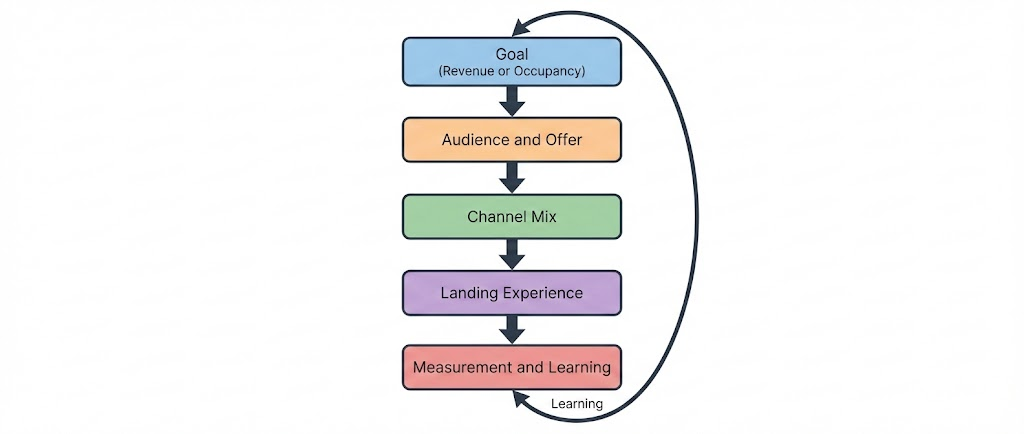
A good digital marketing strategy for hotels also assigns owners. Someone should own content, someone should own paid, and someone should own reporting.
Website Optimization and SEO: The Foundation of Hotel Internet Marketing
A hotel website must load fast, answer questions, and make booking easy. Do not hide room details behind pop-ups and sliders.
This is where hospitality internet marketing starts: the site, the booking engine, and the path from search to confirmation.
Build a reliable hotel internet marketing strategy with these steps:
- Improve mobile speed and Core Web Vitals
- Create unique pages for room types, packages, and events
- Add strong internal linking between offers, rooms, and local guides
- Make policies clear (cancellation, parking, pets, fees)
If paid and programmatic campaigns matter, a buying tool like BidsCube DSP helps manage audiences, budgets, and reporting in one place.
Content and Storytelling: Building Your Brand Online
Most hotels post content that sounds the same. Travelers ignore it. Focus on specifics: the view, the local street, the seasonal event, and the experience on-site.
Use these formats to support digital marketing in hospitality:
- Local guides with maps and “how to get there” tips
- Room-by-room photo sets with honest captions
- Short videos that show arrival, lobby, and breakfast flow
- Event landing pages for weddings, retreats, and conferences
Place content where it converts. Add internal CTAs inside guides, and connect them to a relevant offer page.
Social Media and Reputation Management
Social can drive discovery, but reviews drive decisions. Treat review replies like customer service, not PR.
This is a core part of digital marketing in hotel industry because it shapes conversion rate across every channel.
Run this weekly routine:
- Reply to new reviews within 48 hours
- Flag recurring issues and send them to operations
- Reuse guest UGC in stories (with permission)
- Post short updates tied to real availability and packages
Some buyers also check vendor credibility through third-party directories such as BidsCube on Clutch.
Email Marketing and Personalization
Email still works because it reaches past guests without paying for every impression. Segment based on behavior, not only demographics.
Use these flows to support a digital marketing strategy for hotel industry revenue:
- Post-stay email with review request and upsell for next visit
- Birthday or anniversary offers for loyal guests
- Seasonal “local events” campaigns tied to real dates
- Abandoned booking follow-up when contact info exists
Keep personalization simple. Use name, stay dates, interests, and basic preference signals. Do not overdo it.
Paid Media and Programmatic Advertising
Paid search captures high intent. Social adds demand and visibility. Programmatic adds scale, control, and flexible targeting beyond one platform.
Hotels often treat paid media as “ads that bring bookings.” That is too narrow. Paid also supports brand recall, metasearch performance, and repeat visits.
Use this split for hotel digital marketing strategies:
- Search: brand defense, local intent, and high-value package terms
- Social: discovery, UGC amplification, and remarketing
- Programmatic: reach, frequency control, and cross-site retargeting
Programmatic Advertising: What It Is, and Why Hotels Use It More
Programmatic is the automated buying and selling of ad inventory through ad tech systems. IAB UK describes it as an automated process that connects advertisers and publishers to deliver ads based on rules and data.
For hotels, programmatic works well when the message depends on timing and intent. It can reach travelers while they read travel content, watch video, or use apps.
Common programmatic use cases in hospitality digital marketing:
- Prospecting based on travel intent and contextual signals
- Retargeting website visitors who viewed rooms but did not book
- Geo-based targeting around airports, venues, or competitor hotels
- Video and CTV awareness to support peak-season demand
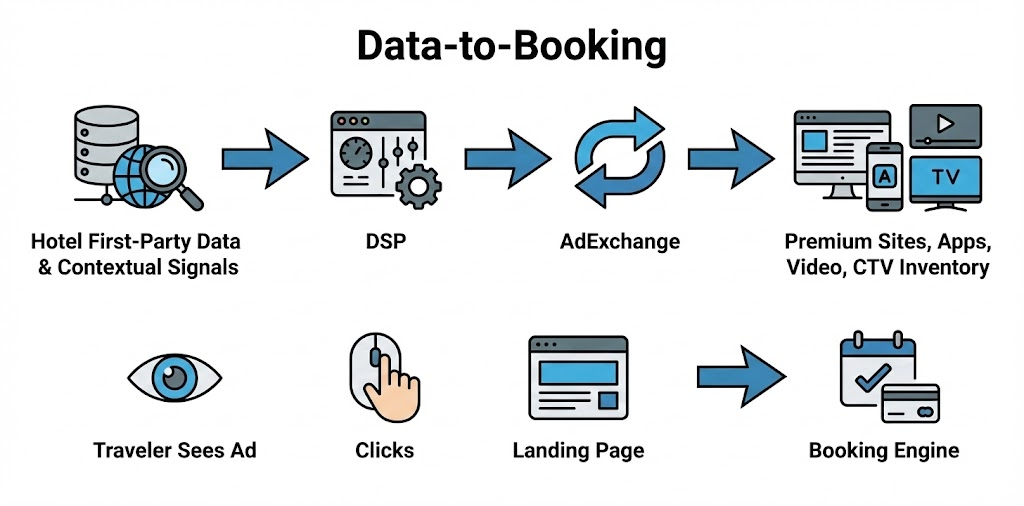
Programmatic also helps hotels control frequency. That matters in digital marketing for tourism and hospitality, because too many impressions can waste budget and annoy travelers.
For teams that want their own branded marketplace layer, review BidsCube White-Label AdExchange.
White-Label Angle for Hospitality Groups and Agencies
Some hotel groups and agencies want more control over tech, UI, and reporting. White-label platforms support that model.
A typical stack can include:
- A sell-side layer to manage supply and yield: BidsCube SSP
- A buy-side layer for media buying and retargeting: BidsCube DSP
- A marketplace layer for direct trading: BidsCube White-Label AdExchange
- Video delivery and reporting: white-label video ad server
If reviews matter in procurement, check BidsCube White-Label AdExchange reviews on G2.
Measuring Success: KPIs for Hospitality Marketing
Track what drives revenue, not what looks good in a dashboard. Combine media KPIs with booking KPIs.
KPIs That Matter by Funnel Stage
| Funnel Stage | What To Track | Why It Matters |
| Awareness | Reach, video completion rate, frequency | Sets demand and recall |
| Consideration | Engaged sessions, return visits, metasearch lift | Shows intent growth |
| Conversion | Booking rate, cost per booking, ROAS | Ties spend to revenue |
| Retention | Repeat booking rate, email revenue share | Reduces acquisition cost |
To keep tracking clean across channels, enforce one naming convention for campaigns. Use consistent UTMs and event tracking.
Real Examples
These are realistic patterns hotels use. Results vary by market, property type, and season.
Example 1: Independent Hotel Builds Direct Demand
The hotel rebuilt SEO pages for top room types and local events. It ran retargeting ads to visitors who checked rates but did not book. Direct bookings rose, and OTA share fell over one quarter.
Example 2: City Hotel Uses Programmatic for Event Weeks
The hotel targeted travelers reading conference-related content and used geo targeting around the venue. It limited frequency, and it rotated creative by date. The hotel saw higher occupancy during event windows without heavy discounts.
Example 3: Resort Improves Repeat Stays
The resort segmented past guests by stay purpose (family vs couples). It sent personalized offers and used paid media to support non-openers. The resort increased repeat bookings and reduced paid dependence over time.
Expert Insight
Roman Vasyukov, CEO and Founder at BidsCube, frames programmatic as more than “buying media.” His point focuses on connecting the pieces that hotels often keep separate.
Great programmatic partners do more than provide technology. They help you connect the dots between data, creative, and business outcomes.
For hotels, that “dots” list often includes rate strategy, landing experience, and measurement. If any of those breaks, paid media becomes expensive fast.
Conclusion
Hotels win online when they pair strong foundations with smart distribution. SEO and content build trust. Social and reviews reduce doubt. Email builds repeat demand. All these work in synergy in digital marketing for hospitality industry.
Programmatic adds reach and control across the open web. It supports both awareness and retargeting, and it helps grow direct bookings when tracking stays clean.
Our tech staff and AdOps are formed by the best AdTech and MarTech industry specialists with 10+ years of proven track record!

FAQ
What are the first steps a small or independent hotel should take to establish an effective digital marketing for hotel industry presence?
The first step requires developers to create basic elements which include exact property listings and instant mobile access and easy room page exploration and easy booking processes. Create 5–10 high-intent pages which should include rooms and packages and events and local guides. The system requires two new functions which include review response management and a single email collection system.
How does programmatic advertising help hotels reach potential guests compared to standard display or social ads?
Programmatic buys inventory across many sites and apps through automated auctions which uses rules to determine targeting and frequency settings. The platform does not restrict users from accessing its content through any particular social media platform. The system allows users to find their preferred travel options by using their present location and their search history data.
What’s the best way to balance direct booking incentives with maintaining visibility on online travel agencies and metasearch platforms?
The system requires OTAs to discover new customers but it needs to operate direct booking as its main revenue stream while monitoring market trends. The company needs to establish benefits which follow parity rules through flexible policies and loyalty perks and upgrade opportunities. The company needs to track its channel performance on a weekly basis because incentives should not reduce the overall revenue.
Which data privacy considerations should hotel marketers keep in mind when using guest data for personalization and targeted campaigns?
You should implement basic consent procedures which should include complete documentation of your data storage policies and you should obtain only necessary user information. The system needs to store marketing identifiers independently from all guest sensitive information which guests share during their hotel stay. The tracking system needs to follow local privacy regulations which include cookie consent rules for retargeting operations.
How can hotels accurately measure the return on investment ROI for their digital marketing activities across multiple channels?
Track from click to booking confirmation, and connect booking value to the source. The system requires users to maintain uniform UTMs and server-based conversion tracking when available and they should use one reporting interface for all their needs. The system needs to monitor all calls which stem from offline customer interactions while it must request customers to specify their visit origin when they arrive at the front desk.


