



Discover the difference between Google AdSense and Google Ad Exchange. Discover which best one can drive the right advertisers, higher revenue, and simpler ad management onto your site.
Table of Contents
- Understanding Google AdExchange and AdSense
- Key Differences Between Google AdExchange and AdSense
- Benefits of Google AdSense
- Benefits of Google AdExchange
- Challenges and Limitations of Each Platform
- How to Choose Between AdSense and Google AdExchange
- Tools and Resources for Maximizing Performance on Both Platforms
- Conclusion
- FAQs
One of the main choices involves Google’s well-known ad platforms. Google Ad Exchange and AdSense hold key positions in this space. Their differences matter for publishers of all sizes.
In this article, I will discuss the difference between AdSense and Google Ad Exchange. You will discover who prefers one over the other. Here you will find some tips to get you a wise decision on what platform is most appropriate for your business objectives. We will additionally review how to get better results, who is eligible and revenue models.
Understanding Google AdExchange and AdSense
To begin with, let us analyze the basics of these two popular Google products before we zero in on which suits you best. They advertise websites but vary in degree, function and necessities. By grasping these essentials, you will be able to look at each platform and how they may serve you.
What is Google AdSense?
Google AdSense is an advertisement display network, targeting advertisement programming, ad network, a continuation of program for publishers and bloggers, and monetization programming. Publishers can then place the AdSense code once approved, and all demand, ad serving, and basic optimizations are taken care of by Google.
AdSense is easiest for smaller sites, focused blogs, and publishers without ad ops teams. According to Google, AdSense for Content publishers receive 80 percent of revenue after the advertiser platform takes its fee and roughly 68 percent when Google Ads buys display ads on AdSense.
What is Google Ad Exchange?
Google Ad Exchange, also called AdX, is a tool for publishers that want more control over demand, pricing, and the auction setup. It works in conjunction with Google Ad Manager, where publishers manage inventory, rules, demand sources, and access to Ad Exchange features. Google Ad Manager also enables real-time bidding, including Open Bidding, whereby exchanges and other buyers can bid for publisher inventory.
When comparing Google AdSense vs Google Ad Exchange, the key difference for publishers is control. AdSense keeps monetization simple. AdX vs AdSense providers more in-depth auction and pricing tools for larger publishers
Core Similarities Between AdSense and Google AdExchange
The two platforms essentially empower publishers to monetize their ad inventory by leveraging the power of Google’s advertising ecosystem. They share support for popular ad formats, reporting, policy controls, and advertiser demand. The difference, however, is in the fundamental objective. The matter is in how much of control, scale, and setup work that each one takes.
| Feature | AdSense | Ad Exchange |
| Provider | Google, through Google Ad Manager | |
| Main purpose | Simple website monetization | Advanced publisher monetization |
| Ad formats | Display, native, text, video | Display, video, native, programmatic demand |
| Reporting | Basic performance reports | Deeper reporting through Google Ad Manager |
| Policy controls | Google publisher policies | Google publisher policies plus more operational checks |
This is why AdSense vs Ad Exchange is less about “good or bad” and more about publisher maturity.
Key Differences Between Google AdExchange and AdSense
AdSense and Ad Exchange handle the same main task, showing ads, but differ in many ways. You will find differences in eligibility, revenue models, and control over inventory.
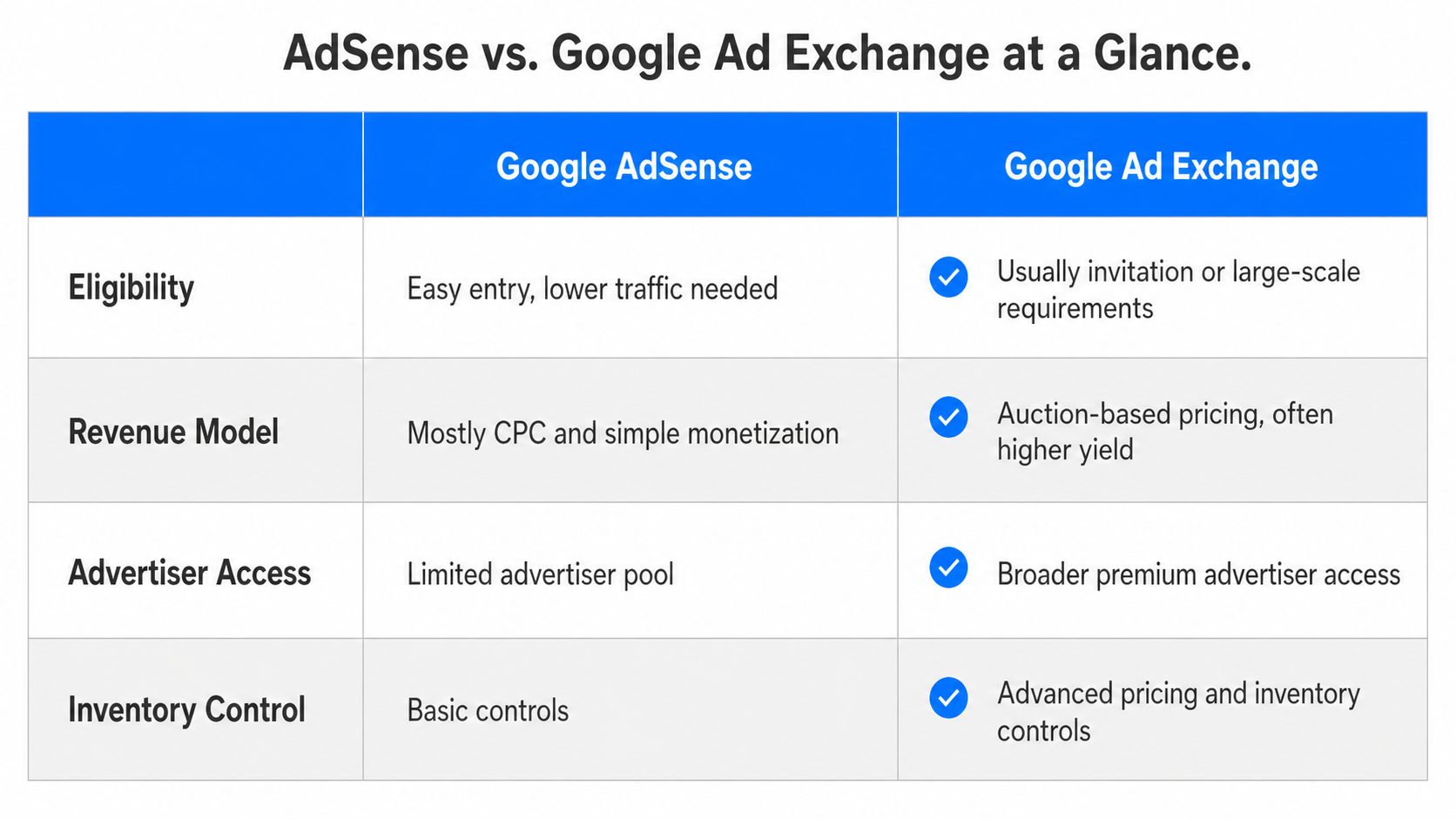
Let’s move through these differences step by step.
1. Eligibility Requirements and Access
AdSense has a lower entry point. Publishers need original content, policy compliance, and a site that Google can review. It suits smaller publishers because it does not require a large sales team or advanced ad stack.
Ad Exchange usually fits larger publishers or publishers working through partners. Access often depends on traffic quality, compliance history, technical readiness, and Google Ad Manager setup. Some publishers also use a certified or specialized partner when they do not have enough internal ad ops capacity.
2. Revenue Models: Direct Sales vs. Real-Time Bidding
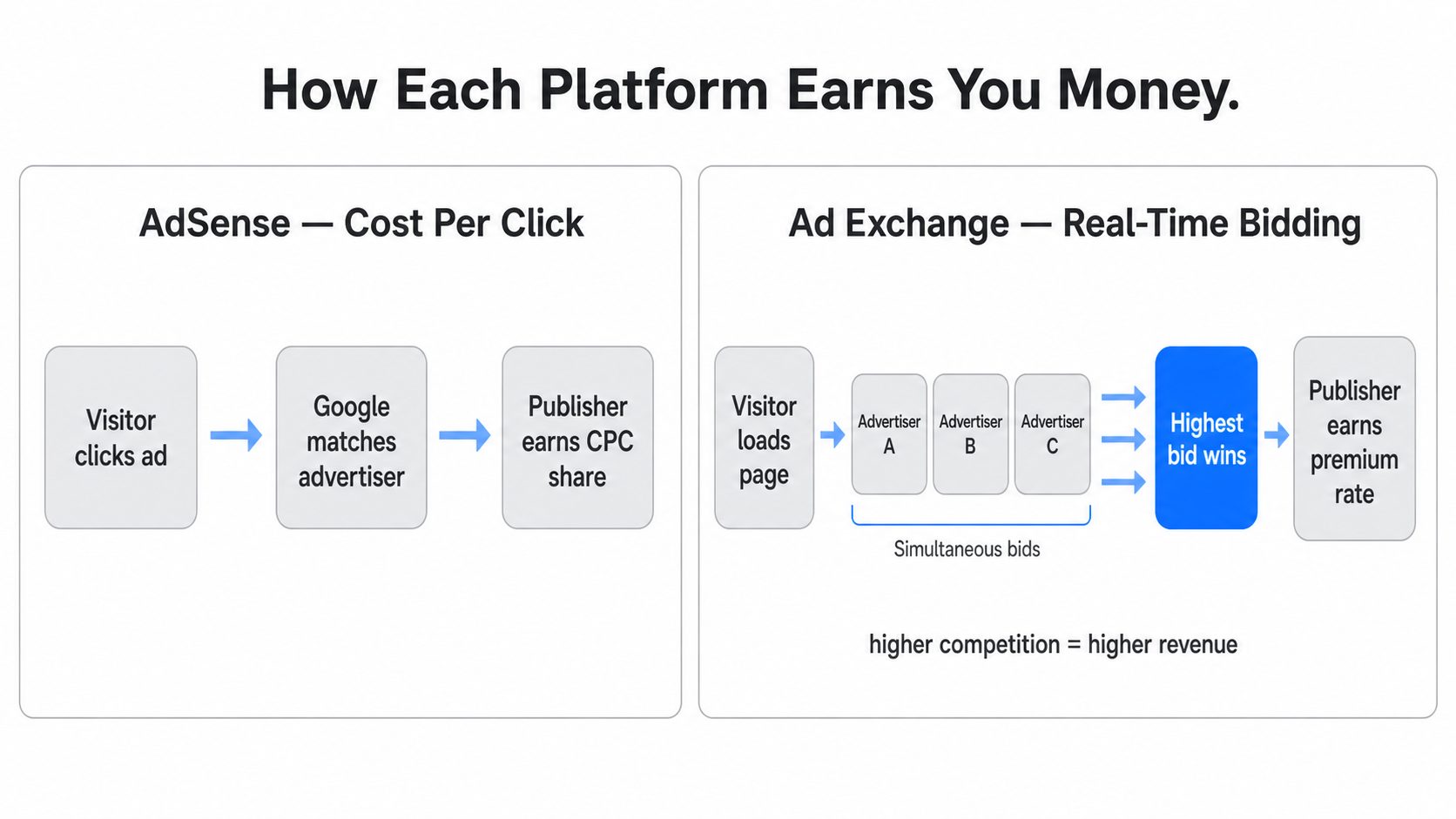
AdSense now pays publishers on an impression-based model rather than mainly CPC for content ads. Google updated AdSense to eCPM-style payments, while the revenue share structure still depends on the advertiser platform fee before the publisher share.
Ad Exchange focuses on auction competition. Buyers can bid in real time, and publishers can use pricing rules, floor prices, preferred deals, private auctions, and programmatic demand. That makes Google AdX vs Google AdSense a practical question for publishers that need ad revenue optimization beyond basic automated ads.
3. Audience and Inventory Control
AdSense gives publishers basic blocking and category controls. It handles most matching and delivery decisions automatically. This reduces work, but it also limits how much the publisher can adjust demand strategy.
Ad Exchange gives publishers stronger control inside Google Ad Manager. Publishers can segment inventory, manage pricing rules, connect demand partners, and make more advanced decisions by format, device, audience, and placement. This matters for media companies, CTV publishers, and sites with multiple inventory tiers.
4. Access to Advertisers and Pricing Flexibility
AdSense gives access to Google advertiser demand without deep setup. That is useful for smaller publishers, but pricing flexibility remains limited. Publishers mainly depend on Google’s automatic matching.
Ad Exchange gives access to a broader programmatic buying setup through a real-time bidding platform. Publishers can use Google Ad Manager tools and connect more demand paths. Google’s Open Bidding lets third-party exchanges compete in one real-time auction, which can increase demand competition for eligible publishers.
| Parameter | AdSense | Ad Exchange |
| Best fit | Small and mid-sized publishers | Large publishers and advanced ad ops teams |
| Setup | Simple code placement | Google Ad Manager setup |
| Revenue control | Limited | Advanced floors, deals, and rules |
| Demand access | Google advertiser demand | Broader programmatic and exchange demand |
| Operations load | Low | Medium to high |
For quick tracking, AdX vs AdSense means advanced auction control versus easier setup. Now that we know the key differences, let’s explore what each platform offers regarding benefits.
Benefits of Google AdSense
AdSense appeals to newcomers and smaller publishers. Let’s see why it remains a go-to choice for many.
Benefit 1. Easy Setup and Accessibility for Small Publishers
AdSense is easy to launch after approval. Publishers add code, choose placements, and let Google manage demand. It works well when a site needs revenue but does not have an ad operations team.
Benefit 2. Simplified Monetization for Niche Websites
Niche publishers can use AdSense without direct advertiser relationships. Google matches ads to content, user signals, and available demand. This keeps monetization manageable for smaller content teams.
Benefit 3. Low Maintenance and Google’s Built-In Support
AdSense reduces daily ad management work. Publishers can use Google’s dashboard, reports, help content, and policy alerts. This makes AdSense useful for teams that want simple income rather than custom yield strategy.
Benefits of Google AdExchange
Google Ad Exchange suits publishers who want more revenue and control. Let’s see how it can help established websites reach new heights.
Benefit 1. Higher Revenue Potential for Large Publishers
Ad Exchange can create stronger competition for valuable inventory. Large publishers can set pricing rules, manage buyers, and test demand paths. Better control can support higher yield when the inventory has real demand.
Benefit 2. Advanced Tools for Audience Targeting and Segmentation
Ad Exchange connects buyers and sellers through Google Ad Manager which allows publishers complete control over inventory and audience rules. Publishers can organize supply by placement, format, device, content type, and buyer access. This can support stronger ad revenue optimization.
Benefit 3. Real-Time Bidding and Access to Premium Advertisers
Ad Exchange provides access to inventory from multiple ad exchanges with real-time bidding capabilities and additional programmatic demand. AdX can be combined with direct deals, Open Bidding and header bidding setups by publishers. For some teams, a White Label AdExchange can add more control over marketplace logic outside a standard Google-only setup.
| Benefit | AdSense | Ad Exchange |
| Setup speed | Fast | Slower, more technical |
| Ease of use | High | Medium |
| Revenue control | Basic | Advanced |
| Demand competition | Standard Google demand | Broader auction competition |
| Best value | Smaller sites | Scaled publishers |
This table sums up AdSense vs AdX from a publisher value perspective.
Challenges and Limitations of Each Platform
No platform is perfect. AdSense and Google Ad Exchange pose their hurdles. Let’s look at what might hold you back.
AdSense: Lower Revenue Potential for High-Traffic Sites
AdSense can limit revenue for publishers with premium audiences or high traffic. The platform works well for simple monetization, but it offers fewer ways to control floors, deals, and demand paths. Large publishers may outgrow it.
Google AdExchange: Complexity and Eligibility Barriers
Ad Exchange needs stronger ad ops knowledge. Publishers also have to handle all of the Google Ad Manager settings, set pricing logic, define buyer rules, reporting structures, and policy checks. Smaller teams may need a partner or a separate SSP for publishers to manage supply more effectively.
Compliance Requirements and Ad Policy Management
AdSense has strict content and traffic quality rules. Ad Exchange adds more operational complexity because publishers manage more demand relationships, auction settings, and inventory controls. Compliance complexity is higher in Ad Exchange because one weak setup can affect brand safety, policy risk, and buyer trust.
How to Choose Between AdSense and Google AdExchange
What the right one for you will be will depend on how your current traffic, goals and technical ability. Well, let us consider some points that will help you in deciding.
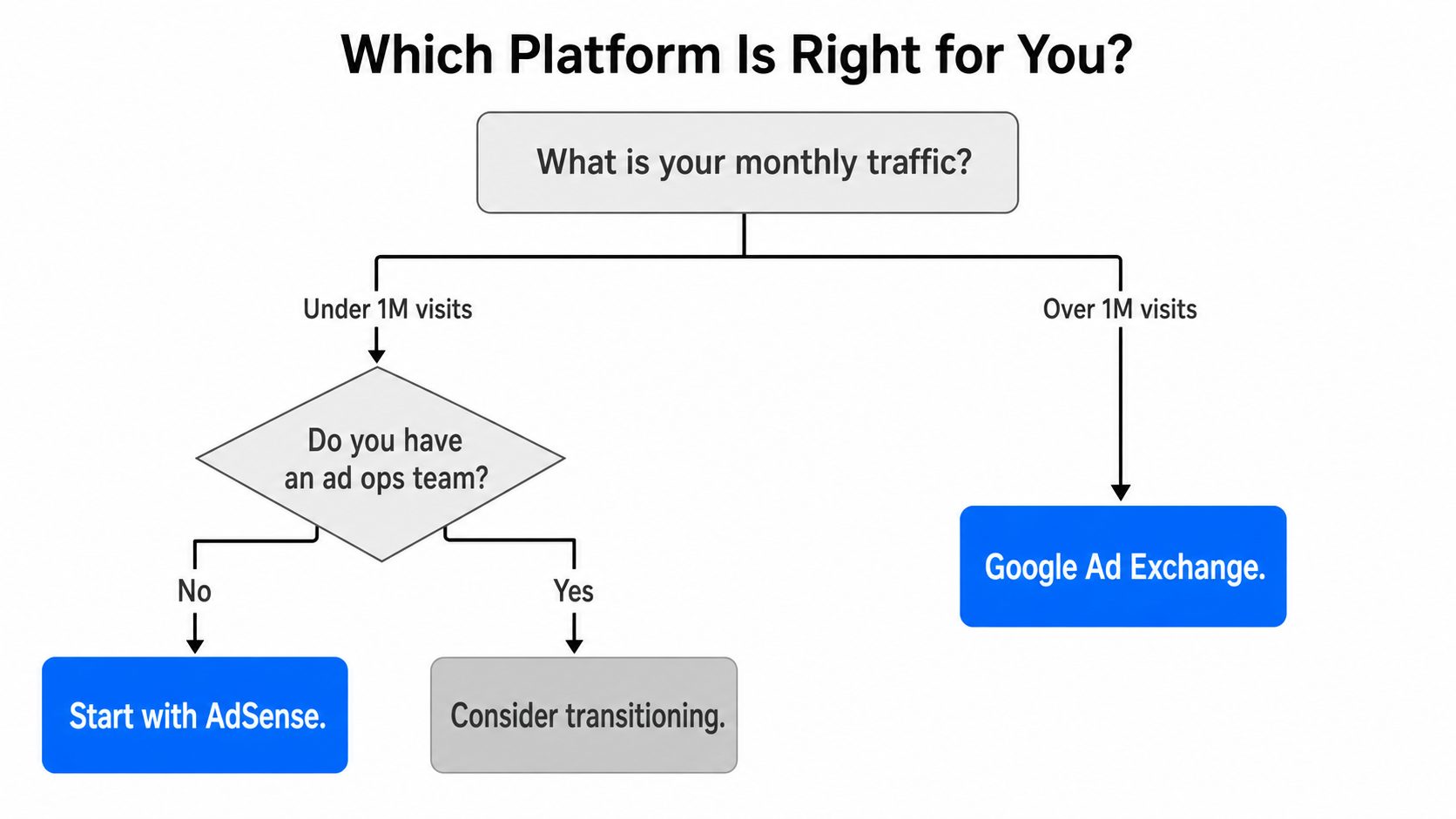
Factors to Consider
Use this table when comparing Google AdX vs Google AdSense for your site.
| Factor | AdSense Fit | Ad Exchange Fit |
| Traffic volume | Low to medium | High and consistent |
| Team size | Solo publisher or small team | Ad ops or monetization team |
| Technical setup | Basic | Advanced Google Ad Manager setup |
| Revenue goal | Simple passive income | Higher yield and deeper control |
| Demand strategy | Google-managed demand | Multi-buyer auction strategy |
For larger programmatic setups, publishers can also review BidsCube’s DSP, SSP, and vendor profiles on Clutch and G2.
Use Cases for AdSense vs. AdExchange Google
Different websites have different needs. Let’s consider scenarios.
- Small Blogs or Hobby Sites. A personal blog with a few thousand monthly visitors may start with AdSense. This provides a simple income without heavy management.
- Niche Information Sites. A speciality site about rare hobbies can use AdSense to serve relevant ads to a smaller audience. This keeps things easy and low-risk.
- Large News Portals or Media Brands. A big publisher with millions of visitors can try Ad Exchange. They benefit from higher bids, premium advertisers, and advanced segmentation.
- Well-Established Content Networks. Content networks with staff, analysts, and ad managers can optimise Ad Exchange. They can fine-tune pricing floors and use A/B testing to boost revenue.
What if you start with AdSense and grow to a point where Ad Exchange seems better?
Transitioning from AdSense to Google AdExchange: When and How
Many publishers begin with AdSense and switch later as they grow.
Look at your site’s growth. If your traffic and revenue plateau, consider applying for access to the Google Ad Exchange through a Google partner. Review your audience segments. If you see consistent demand or repeated high value bids in AdSense, that may be a signal that you may earn more with Google Ad Exchange. Finally, transitioning is learning to use new tools, hiring experts, or finding experts. Start small. Test a portion of your inventory on Ad Exchange before going all in.
Choosing between platforms involves careful thought. But no matter which you pick, you can use various tools to improve performance.
Tools and Resources for Maximizing Performance on Both Platforms
Publishers using either platform should focus on layout quality, reporting, and demand competition. Start with ad placement tests, page speed checks, mobile formats, and performance reports. Then track fill rate, viewability, eCPM, CTR, and revenue by page type.
Header bidding can also help larger publishers increase demand competition. Open-source wrapper solutions such as Prebid.js let header bidding publishers invite demand partners before the ad server decision. Prebid describes Prebid.js as an open-source header bidding platform with hundreds of demand sources and analytics adapters.
For AdSense vs Adx, the rule is simple. Optimise layout first. Add auction complexity only when the site has enough traffic, demand, and technical support to justify it.
Integrating Header Bidding with Google AdExchange
Header bidding works with an auction where multiple advertisers compete before the ad server calls the winner.
Header bidding allows multiple demand sources to bid concurrently, which usually ramps up your total revenue. Header Bidding — Google Ad Exchange is a perfect fit. This can lead to competitive pressure and allows you to earn more money. Header bidding is used by a number of larger publishers to create an additional layer of competition. If you operate a connected TV (CTV) platform, you could bring several buyers into competition in real time and, thereby, maximize your final ad rates.
Simply, these tools will help you get better results regardless of your platform.
Conclusion
The Google AdSense vs Google Ad Exchange choice depends on your site size, team capacity, and monetization goals. AdSense fits publishers that need a simple setup and low daily maintenance. Ad Exchange fits publishers that need deeper auction control, better demand access, and stronger reporting through Google Ad Manager.
If your current setup limits yield, compare AdSense vs Ad Exchange, then review whether a broader programmatic stack can give you more control. Start with BidsCube’s SSP, DSP, or white-label ad exchange if you want more ownership over monetization workflows.
Our tech staff and AdOps are formed by the best AdTech and MarTech industry specialists with 10+ years of proven track record!

FAQs
What Is the Difference Between Google AdSense and Google Ad Exchange?
The main difference is control. AdSense provides easy monetization for small publishers and Ad Exchange provides advanced auction, pricing, and demand management through Google Ad Manager for larger publishers.
Which Publishers Can Use Google Ad Exchange?
Google Ad Exchange usually fits publishers with strong traffic, clean inventory, policy compliance, and the ability to manage Google Ad Manager. Some publishers access Ad Exchange through a partner when they do not manage the full setup internally.
Does Google Ad Exchange Pay More Than AdSense?
Google Ad Exchange can pay more when a publisher has valuable inventory and enough demand competition. The result depends on traffic quality, audience value, floor pricing, ad formats, and partner setup.
Can I Use Both AdSense and Ad Exchange at the Same Time?
Yes, some publishers use both AdSense and Ad Exchange as part of a broader Google Ad Manager setup. The right setup depends on inventory rules, demand priorities, and how the publisher manages auctions.


